Home » Ethics (Page 3)
Category Archives: Ethics

– Making Algorithms Trustworthy
Algorithms can determine whether you get a loan, predict what diseases you might get and even assess how long you might live. It’s kind of important we can trust them!
David Spiegelhalter is the Winton Professor for the Public Understanding of Risk in the Statistical Laboratory, Centre for Mathematical Sciences at the University of Cambridge. As part of the Cambridge Science Festival he was talking (21st of March 2019) on the subject of making algorithms trustworthy.
I’ve heard David speak on many occasions and he is always informative and entertaining. This was no exception.

Algorithms now regularly advise on book and film recommendations. They work out the routes on your satnav. They control how much you pay for a plane ticket and, annoyingly, they show you advertisements that seem to know far too much about you.
But more importantly they can affect life and death situations. The results of an algorithmic assessment of what disease you might have could be highly influential, affecting your treatment, your well-being and on your future behaviour.
David is a fan of Onora O’Neill who suggests that organisations should not be aiming to increase trust but should aim to demonstrate trustworthiness. False claims about the accuracy of algorithms are as bad as defects in the algorithms themselves.

The pharmaceutical industry has long used a phased approach assessing the effectiveness, safety and side-effects of drugs. This includes the use of randomly controlled trials, and long-term surveillance after a drug comes onto the market, to spot rare side-effects.
The same sorts of procedures should be applied to algorithms. However, currently only the first phase of testing on new data is common. Sometimes algorithms are tested against the decisions that human experts make. Rarely will randomly controlled trials be conducted, or the algorithm in use be subject to long-term monitoring.


Algorithms should be transparent. They should be able to explain their decisions as well as to provide them. But transparency is not enough. O’Neill uses the term 'intelligent openness’ to describe what is required. Explanations need to be accessible, intelligible, usable, and assessable.
 Algorithms need to be both globally and locally explainable. Global explainability relates to the validity of the algorithm in general, while local explainability relates to how the algorithm arrived at a particular decision. One important way of being able to test an algorithm, even when it’s a black box, is to be able to play with inputting different parameters and seeing the result.

Deep Mind (owned by Google) is looking at how explanations can be generated from intermediate stages of the operation of machine learning algorithms.
Explanation can be provided at many levels. At the top level this might be a simple verbal summary. At the next level it might be having access to a range of graphical and numerical representations with the ability to run 'what if' queries. At a deeper level, text and tables might show the procedures that the algorithm used. Deeper still, would be the mathematics underlying the algorithm. Lastly, the code that runs the algorithm should be inspectable. I would say that a good explanation is dependent on understanding what the user wants to know - in other words, it is not just a function of the decision making process but also a function of the user’s actual and desired state of knowledge.

 Without these types of explanation, algorithms such as the one used by the US company Compas to predict rates of recidivism, are difficult to trust.
It is easy to feel that an algorithm is unfair or can’t be trusted. If it cannot provide sufficiently good explanations, and claims about it are not scientifically substantiated, then it is right to be sceptical about its decisions.
Most of David’s points apply more broadly than to artificial intelligence and robots. They are general principles applying to the transparency, accountabilityand user acceptance of any system. Trust and trustworthiness are everything.
See more of David’s work on his personal webpage at http://www.statslab.cam.ac.uk/Dept/People/Spiegelhalter/davids.html , . And read his new book “The Art of Statistics: Learning from Data”, available shortly.


David Spiegelhalter

– Its All Broken, but we can fix it
Democracy, the environment, work, healthcare, wealth and capitalism, energy and education - it’s all broken but we can fix it. This was the thrust of the talk given yesterday evening (19th March 2019) by 'Futurist' Mark Stevenson as part of the University of Cambridge Science Festival. Call me a subversive, but this is exactly what I have long believed. So I am enthusiastic to report on this talk, even though it is as much to do with my www.wellbeingandcontrol.com website than it is with AI and Robot Ethics.
Moral Machines?
This talk was brought to you, appropriately enough, by Cambridge Skeptics. One thing Mark was skeptical about was that we would be saved by Artificial Intelligence and Robots. His argument - AIs show no sign of becoming conscious therefore they will not be able to be moral.  There is something in this argument. How can an artificial Autonomous Intelligent System (AIS) understand harm without itself experiencing suffering? However, I would take issue with this first premise (although I agree with pretty much everything else). First, assuming that AIs cannot be conscious, it does not follow that they cannot be moral. Plenty of artefacts have morals designed in - an auto-pilot is designed not to kill its passengers (leaving aside the Boeing 737 Max), a cash machine is designed to give you exactly the money you request and buildings are designed not to fall down on their occupants. OK, so this is not the real-time decision of the artefact. Rather it's that of the human designers. But I argue (see the right-hand panel of some blog page on www.robotethics.co.uk) that by studying what I call the Human Operating System (HOS) we will eventually get at the way in which human morality can be mimicked computationally and this will provide the potential for moral machines.
The Unpredictable...
Mark then went on to show just how wrong attempts at prediction can be. "Cars are a fad that will never replace the horse and carriage". "Trains will never succeed because women were not designed to travel at more than 50 mile per hour". 
We are so bad at prediction because we each grow up in our own unique situations and it's very difficult to see the world from outside our own box - when delayed on the M11 don't think you are in a traffic jam, you are the traffic jam! Prediction is partly difficult because technology is changing at an exponential rate. Once it took hundreds of years for a technology (say carpets) to be generally adopted. The internet only took a handful of years.
...But Possible
Having issued the 'trust no prediction' health warning, Mark went on to make a host of predictions about self-driving cars, jobs, education, democracy and healthcare. Self-driving cars, together with cheap power will make owning your own car economically unviable. You will hire cars from a taxi pool when you need them. You could call this idea 'CAAS - Cars As A Service' (like 'SAAS - Software As A Service') where all the pains of ownership are taken care of by somebody else.
AI and Robots will take all the boring cognitively light jobs leaving people to migrate to jobs involving emotions. (I'm slightly skeptical about this one also, because good therapeutic practices, for example, could easily end up within the scope of chatbots and robots with integrated chatbot sub-systems). Education is broken because it was designed for a 1950s world. It should be detached from politics because at the moment educational policy is based on the current Minister of Education's own life history. 'Education should be in the hands of educationalists' got an enthusiatic round of applause from the 300+ strong audience - well, it is Cambridge, after all.
Parliamentary democracy has hardly changed in 200 years. Take a Corbyn supporter and a May supporter (are there any left of either?). Mark contends that they will agree on 95% of day to day things. What politics does is 'divide us over things that aren't important'. Healthcare is dominated by the pharmaceutical industry that now primarily exists to make money. It currently spends twice the amount on marketing than it does on research and development. They are marketing, not drug companies.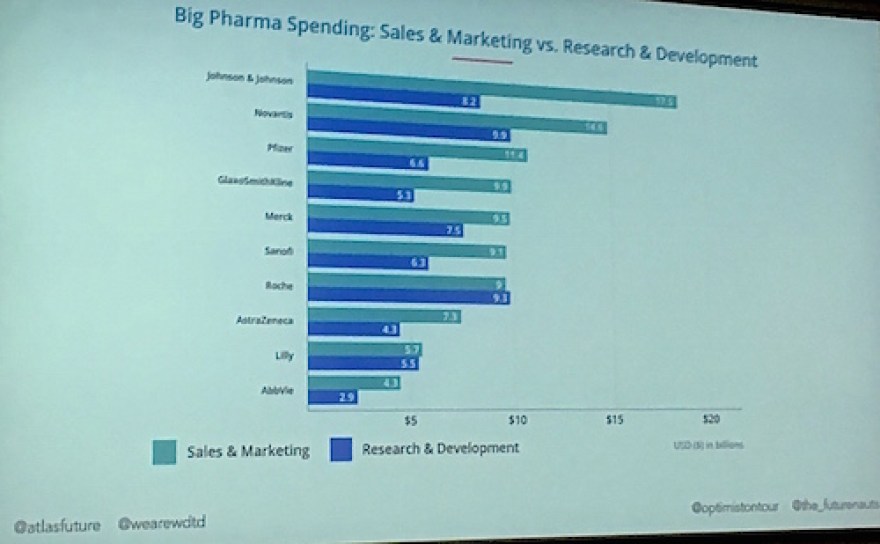
While every company espouses innovation as one of its key values, for the most part it's just platitude or a sham. It's generally in the interest of a company or industry to maintain the status quo and persuade consumers to buy yet more useless products. Companies are more interested in delivering shareholder value than anything truly valuable.
Real innovation is about asking the right questions. Mark has a set of techniques for this and I am intrigued as to what they might be (because I do too!).
We can fix it - yes we can
 On the positive side, it's just possible that if we put our minds to it, we can fix things. What is required is bottom up, diverse collaboration. What does that mean? It means devolving decision-making and budgeting to the lowest levels.
For example, while the big pharma companies see no profit in developing drugs for TB, the hugely complex problem of drug discovery can be tackled bottom up. By crowd-sourcing genome annotations, four new TB drugs have been discovered at a fraction of the cost the pharma industry would have spent on expensive labs and staff perks. 
 While the value of this may not show on the balance sheet or even a nation's GDP, the value delivered to those people whose lives are saved is incalculable. This illustrates a fundamental flaw in modern capitalism - it concentrates wealth but does not necessarily result in the generation of true value. And the people are fed up with it.
Some technological solutions include 'Blockchain',that Mark describes as 'double entry bookkeeping on steroids'. Blockchain can deliver contracts that are trustworthy without the need for intermediary third parties (like banks, accountants and solicitors) to provide validation. Blockchain provides 'proof' at minuscule cost, eliminating transactional friction. Everything will work faster, better.
Organs can be 3D printed and 'Nanoscribing' will miniaturise components and make them ridiculously cheap. Provide a blood sample to your phone and the pharmacist will 3D print a personalised drug for you.
 I enjoyed this talk, not least because it contained a lot of the stuff I've been banging on about for years (see: www.wellbeingandcontrol.com). The difference is that Mark has actually brought it all together into one simple coherent story - everything is broken but we can fix it. See Mark Stevenson's website at: https://markstevenson.org


– What does it mean to be human?
John Wyatt

– Ethical AI
Writing about ethics in artificial intelligence and robotics can sometimes seem like it’s all doom and gloom. My last post for example covered two talks in Cambridge – one mentioning satellite monitoring and swarms of drones and the other going more deeply into surveillance capitalism where big companies (you know who) collect data about you and sell it on the behavioural futures market.
So it was really refreshing to go to a talk by Dr Danielle Belgrave at Microsoft Research in Cambridge last week that reflected a much more positive side to artificial intelligence ethics. Danielle has spent the last 11 years researching the application of probabilistic modelling to the medical condition of asthma. Using statistical techniques and machine learning approaches she has been able to differentiate between five more or less distinct conditions that are all labelled asthma. Just as with cancer there may be a whole host of underlying conditions that are all given the same name but may in fact have different underlying causes and environmental triggers.

This is important because treating a set of conditions that may have family resemblance (as Wittgenstein would have put it) with the same intervention(s) might work in some cases, not work in others and actually do harm to some people. Where this is leading, is towards personalised medicine, where each individual and their circumstances are treated as unique. This, in turn, potentially leads to the design of a uniquely configured set of interventions optimised for that individual.
The statistical techniques that Danielle uses, attempt to identify the underlying endotypes (sub-types of a condition) from set of phenotypes (the observable characteristics of an individual). Some conditions may manifest in very similar sets of symptoms while in fact they arise from quite different functional mechanisms.
Appearances can be deceptive and while two things can easily look the same, underneath they may in fact be quite different beasts. Labelling the appearance rather than the underlying mechanism can be misleading because it inclines us to assume that beast 1 and beast 2 are related when, in fact the only thing they have in common is how they appear.
It seems likely that for many years we have been administering some drugs thinking we are treating beast 1 when in fact some patients have beast 2, and that sometimes this does more harm than good. This view is supported by the common practice that getting the medication right in asthma, cancer, mental illness and many other conditions, is to try a few things until you find something that works.
But in the same way that, for example, it may be difficult to identify a person’s underlying intentions from the many things that they say (oops, perhaps I am deviating into politics here!), inferring underlying medical conditions from symptoms is not easy. In both cases you are trying to infer something that may be unobservable, complex and changing, from the things you can readily perceive.
We have come so far in just a few years. It was not long ago that some medical interventions were based on myth, guesswork and the unquestioned habits of deeply ingrained practices. We are currently in a time when, through the use of randomly controlled trials, interventions approved for use are at least effective ‘on average’, so to speak. That is, if you apply them to large populations there is significant net benefit, and any obvious harms are known about and mitigated by identifying them as side-effects. We are about to enter an era where it becomes commonplace to personalise medicine to targeted sub-groups and individuals.
It’s not yet routine and easy, but with dedication, skill and persistence together with advances in statistical techniques and machine learning, all this is becoming possible. We must thank people like Dr Danielle Belgrave who have devoted their careers to making this progress. I think most people would agree that teasing out the distinction between appearance and underlying mechanisms is both a generic and an uncontroversially ethical application of artificial intelligence.
Danielle Belgrave

– A Changing World: so, what’s to worry about?
A World that can change – before your eyes!
I’ve been to a couple of good talks in Cambridge (UK) this week. First, futurist Sophie Hackford (formally of Singularity University and Wired magazine) gave a fast-paced talk about a wide range of technologies that are shaping the future. If you don’t know about swarms of drones, low orbit satellite monitoring, neural in-plants, face recognition for payments, high speed trains and rocket transportation then you need to, fast. I haven’t found a video of this very recent talk yet, but the one below from a year ago gives a pretty good indication of why we need to think through the ethical issues.
YouTube Video, Tech Round-up of 2017 | Sophie Hackford | CTW 2017, January 2018, 26:36 minutes
The Age of Surveillance Capitalism
The second talk, in some ways, is even more scary. We are already aware that the likes of Google, Facebook and Amazon are closely watching our every move (and hearing our every breath). And now almost every other company that is afraid of being left behind is doing the same thing, But what data are they collecting and how are they using it. They use the data to predict our behaviour and sell it on the behavioural futures market. Not just our computer behaviour but they are also influencing us in the real world. For example, apparently Pokamon Go was an experiment originally dreamed up by Google to see if retailers would pay to host ‘monsters’ to increase footfall past their stores. The talk by Shoshana Zuboff was at the Cambridge University Law Faculty. Here is an interview she did on radio the same day.
BBC Radio 4, Start the Week, Who is Watching You?, Monday 4th February 2019, 42:00 minutes
https://www.bbc.co.uk/programmes/m0002b8l
