Home » Posts tagged 'Artificial Intelligence'
Tag Archives: Artificial Intelligence

– AI in Politics 2026
AI in Politics – Jan26 – Download .pdf here
Artificial Intelligence in Politics
AI has the potential to change politics and policy making. In fact, it is already doing this. Look at the way social media is using AI to influence election outcomes. However, we need to recruit AI to improve political processes, not seize control of them.
If we do not take stock of this now, there is a real danger that the important decisions influencing UK society will be increasingly made by people and organisations outside the UK political arena. Decision-making processes will become more hidden from public view and the opportunity for debate, scrutiny and accountability will be lost.
In contrast there are many ways in which AI can be used to enhance democratic processes. In the short term, it can enable better civil engagement, aid policy insights and forecasting, increase administrative efficiency and make political processes more transparent. In the longer term it can lead to constitutional innovation, facilitate deliberative democracy, make explicit the trade-offs between the interests of different groups, critique proposed legislation from multiple perspectives, co-ordinate central and local plans, and generally augment government decision-making at all levels.
However, changes to the processes of political and policy decision-making are hugely difficult. Our current systems are deeply embedded and entangled. Habit, complexity and vested interests are intimately related barriers to any change and especially so in relation to political decision-making itself. And often rightly so, because processes that have stood the test of time are important to keep and not disrupt. But AI has come out of left field as a major disruptor to almost everything and its implication for political decision making must be assessed and absorbed. To achieve this, we need to not just focus on how AI can be used to enhance the economy but also how AI can be used to enhance the political decision-making processes themselves.
We are in danger of rolling out AI such that it merely automates our current ways of going about things, embedding some poor practices even further. However, abrupt and radical change is also unacceptable because it is disruptive and de-stabilizing. What is needed is a firm and agreed vision based on sound principles, and a plan of managed transition that works towards new ways of making political decisions incorporating AI, that are based on best practice (e.g. evidence driven, comprehensively consulted, robustly modelled and tested etc.).
This brief paper is a call for us to take stock of what has already been done, both in the research and practice, in using AI for political and policy formulation, decision-making, implementation, monitoring and iterative revision. This sets out the landscape so that we can better plan the journey ahead and help head-off a situation where players outside parliament (large corporations, foreign governments, the media etc.) use their increasingly powerful command of AI to determine the political agenda.
– It’s All Too Creepy
As concern about privacy and use of personal data grows, solutions are starting to emerge.
This week I attended an excellent symposium on ‘The Digital Person’ at Wolfson College Cambridge, organised by HATLAB.
The HATLAB consortium have developed a platform where users can store their personal data securely. They can then license others to use selected parts of it (e.g. for website registration, identity verification or social media) on terms that they, the user, is in control of.

Highlights
Every talk at this symposium was interesting and informative. Some highlights include:
- Misinformation and Business Models: Professor Jon Crowcroft
- Taking back control of Personal Data: Professor Max van Kleek
- Ethics-Theatre in Machine Learning: Professor John Naughton
- Stop being creepy: Getting Personalisation and Recommendation right: Irene Ng
There was also some excellent discussion amongst the delegates who were well informed about the issues.
See the Slides
Fortunately I don’t have to go into great detail about these talks because thanks to the good organisation of the event the speakers slide sets are all available at:
https://www.hat-lab.org/wolfsonhat-symposium-2019
I would highly recommend taking a look at them and supporting the HATLAB project in any way you can.
– Its All Broken, but we can fix it
Democracy, the environment, work, healthcare, wealth and capitalism, energy and education - it’s all broken but we can fix it. This was the thrust of the talk given yesterday evening (19th March 2019) by 'Futurist' Mark Stevenson as part of the University of Cambridge Science Festival. Call me a subversive, but this is exactly what I have long believed. So I am enthusiastic to report on this talk, even though it is as much to do with my www.wellbeingandcontrol.com website than it is with AI and Robot Ethics.
Moral Machines?
This talk was brought to you, appropriately enough, by Cambridge Skeptics. One thing Mark was skeptical about was that we would be saved by Artificial Intelligence and Robots. His argument - AIs show no sign of becoming conscious therefore they will not be able to be moral.  There is something in this argument. How can an artificial Autonomous Intelligent System (AIS) understand harm without itself experiencing suffering? However, I would take issue with this first premise (although I agree with pretty much everything else). First, assuming that AIs cannot be conscious, it does not follow that they cannot be moral. Plenty of artefacts have morals designed in - an auto-pilot is designed not to kill its passengers (leaving aside the Boeing 737 Max), a cash machine is designed to give you exactly the money you request and buildings are designed not to fall down on their occupants. OK, so this is not the real-time decision of the artefact. Rather it's that of the human designers. But I argue (see the right-hand panel of some blog page on www.robotethics.co.uk) that by studying what I call the Human Operating System (HOS) we will eventually get at the way in which human morality can be mimicked computationally and this will provide the potential for moral machines.
The Unpredictable...
Mark then went on to show just how wrong attempts at prediction can be. "Cars are a fad that will never replace the horse and carriage". "Trains will never succeed because women were not designed to travel at more than 50 mile per hour". 
We are so bad at prediction because we each grow up in our own unique situations and it's very difficult to see the world from outside our own box - when delayed on the M11 don't think you are in a traffic jam, you are the traffic jam! Prediction is partly difficult because technology is changing at an exponential rate. Once it took hundreds of years for a technology (say carpets) to be generally adopted. The internet only took a handful of years.
...But Possible
Having issued the 'trust no prediction' health warning, Mark went on to make a host of predictions about self-driving cars, jobs, education, democracy and healthcare. Self-driving cars, together with cheap power will make owning your own car economically unviable. You will hire cars from a taxi pool when you need them. You could call this idea 'CAAS - Cars As A Service' (like 'SAAS - Software As A Service') where all the pains of ownership are taken care of by somebody else.
AI and Robots will take all the boring cognitively light jobs leaving people to migrate to jobs involving emotions. (I'm slightly skeptical about this one also, because good therapeutic practices, for example, could easily end up within the scope of chatbots and robots with integrated chatbot sub-systems). Education is broken because it was designed for a 1950s world. It should be detached from politics because at the moment educational policy is based on the current Minister of Education's own life history. 'Education should be in the hands of educationalists' got an enthusiatic round of applause from the 300+ strong audience - well, it is Cambridge, after all.
Parliamentary democracy has hardly changed in 200 years. Take a Corbyn supporter and a May supporter (are there any left of either?). Mark contends that they will agree on 95% of day to day things. What politics does is 'divide us over things that aren't important'. Healthcare is dominated by the pharmaceutical industry that now primarily exists to make money. It currently spends twice the amount on marketing than it does on research and development. They are marketing, not drug companies.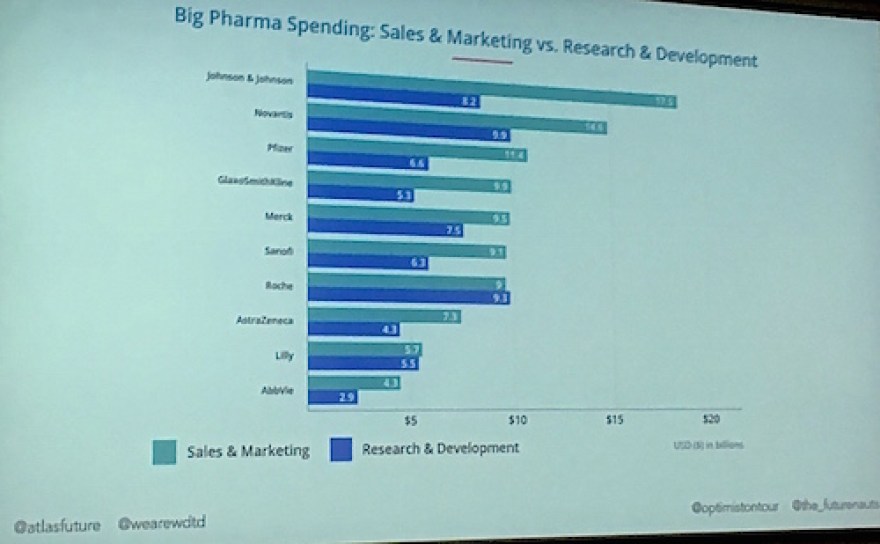
While every company espouses innovation as one of its key values, for the most part it's just platitude or a sham. It's generally in the interest of a company or industry to maintain the status quo and persuade consumers to buy yet more useless products. Companies are more interested in delivering shareholder value than anything truly valuable.
Real innovation is about asking the right questions. Mark has a set of techniques for this and I am intrigued as to what they might be (because I do too!).
We can fix it - yes we can
 On the positive side, it's just possible that if we put our minds to it, we can fix things. What is required is bottom up, diverse collaboration. What does that mean? It means devolving decision-making and budgeting to the lowest levels.
For example, while the big pharma companies see no profit in developing drugs for TB, the hugely complex problem of drug discovery can be tackled bottom up. By crowd-sourcing genome annotations, four new TB drugs have been discovered at a fraction of the cost the pharma industry would have spent on expensive labs and staff perks. 
 While the value of this may not show on the balance sheet or even a nation's GDP, the value delivered to those people whose lives are saved is incalculable. This illustrates a fundamental flaw in modern capitalism - it concentrates wealth but does not necessarily result in the generation of true value. And the people are fed up with it.
Some technological solutions include 'Blockchain',that Mark describes as 'double entry bookkeeping on steroids'. Blockchain can deliver contracts that are trustworthy without the need for intermediary third parties (like banks, accountants and solicitors) to provide validation. Blockchain provides 'proof' at minuscule cost, eliminating transactional friction. Everything will work faster, better.
Organs can be 3D printed and 'Nanoscribing' will miniaturise components and make them ridiculously cheap. Provide a blood sample to your phone and the pharmacist will 3D print a personalised drug for you.
 I enjoyed this talk, not least because it contained a lot of the stuff I've been banging on about for years (see: www.wellbeingandcontrol.com). The difference is that Mark has actually brought it all together into one simple coherent story - everything is broken but we can fix it. See Mark Stevenson's website at: https://markstevenson.org


